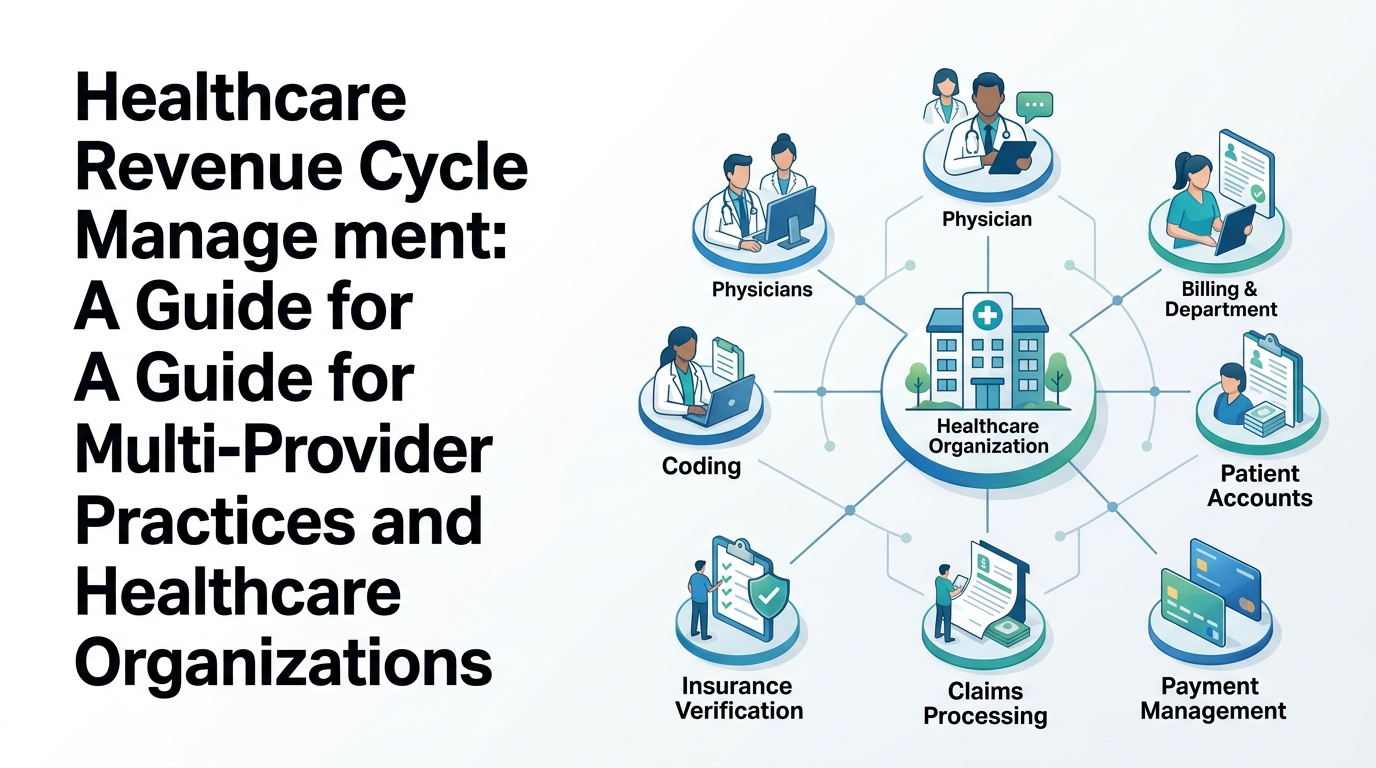


Every healthcare practice runs on the same underlying process, whether or not anyone calls it by name: a patient is seen, a claim is generated, and — eventually, hopefully — the practice gets paid. That process is revenue cycle management, and how well a practice manages it determines whether revenue flows in predictably or gets stuck somewhere between the exam room and the bank account.
This guide breaks down what this process actually includes, the stages every claim moves through, the metrics that reveal whether a practice’s RCM is actually working, and how to decide between managing it in-house or bringing in outside help.
What Is Revenue Cycle Management?
Revenue cycle management refers to the complete financial process a healthcare practice uses to track patient care from the first appointment through final payment. It covers everything that happens administratively and financially around a patient encounter — scheduling and eligibility verification, charge entry, medical coding, claims submission, payment posting, denial management and appeals, and patient collections.
The word “cycle” matters here: this isn’t a single task, it’s a connected sequence, and a breakdown at any point — an eligibility check that’s skipped, a coding error, a denial that never gets appealed — can stall revenue that’s already been earned.
The Three Stages of Revenue Cycle Management
Most practices’ billing and collections processes break down into three broad stages, each with its own failure points.
Front-End: Before the Claim Exists
This stage covers scheduling, insurance eligibility verification, and pre-service financial counseling. Confirming coverage and benefits before an appointment is one of the simplest, highest-leverage steps in the entire cycle — many downstream denials trace back to an eligibility issue that could have been caught here, and patients also get a clearer picture of what they’ll owe before they ever see a bill.
Mid-Cycle: Turning Care Into a Claim
This is where clinical documentation becomes a billable claim: charge capture, medical coding (ICD-10 and CPT), and claims submission. Accuracy here determines whether a claim is accepted on first submission or bounces back as a denial — and because coding requirements vary by specialty, this is usually where generalist billing staff struggle most without specialty-specific training.
Back-End: Collecting What’s Owed
This stage covers payment posting, denial management and appeals, accounts receivable follow-up, and patient billing. Effective RCM treats this stage as active work — tracking every unpaid claim until it’s resolved — rather than a passive waiting period.
Why Revenue Cycle Management Has Gotten Harder
Managing this process well has become more demanding, not less, in recent years. According to MGMA’s most recent DataDive benchmarking data, the single-specialty aggregate rate for claims denied on first submission has held around 8%, and a 2024 MGMA poll found that 60% of medical group leaders reported an increase in their practices’ claim denial rates compared to the prior year — with only 11% reporting improvement. Practice leaders pointed to insufficient documentation, eligibility errors, delayed filing, and improper modifier use as the most common causes.
Payer friction compounds the problem. A recent American Medical Association survey found that physicians complete an average of 43 prior authorizations per week, consuming roughly 12 hours of physician and staff time weekly, with 27% of physicians reporting that prior authorization requests are often or always denied outright. For a practice without a dedicated team managing this process end to end, that administrative load is difficult to absorb without patient care suffering somewhere.
Key Metrics for Measuring Revenue Cycle Management Performance
A practice can’t improve what it doesn’t measure, and relying on gut feel instead of numbers is how small problems turn into six-figure ones. These are the core metrics that reveal whether the revenue cycle is actually working:
- Claims acceptance rate (first-pass rate). The percentage of claims accepted by payers without being returned for correction — a direct signal of coding and documentation accuracy.
- Days in accounts receivable (A/R). How long it takes, on average, to collect payment after a claim is submitted. Lower is better; rising A/R days usually signal a breakdown somewhere in the cycle.
- Net collection rate. The percentage of collectible revenue a practice actually collects, after contractual adjustments — the clearest measure of overall revenue cycle health.
- Denial rate. The percentage of claims denied on first submission, broken down by reason where possible so recurring issues can be fixed at the source.
- Underpayment recovery rate. How often underpaid or partially denied claims are successfully appealed and recovered, rather than written off.
In-House vs. Outsourced Revenue Cycle Management
Keeping this function in-house gives a practice direct day-to-day control, but it also means carrying the full cost of hiring, training, and retaining certified coders and billing specialists — and absorbing the resulting expertise gap whenever someone leaves. Certified coders and experienced billers are in high demand, and losing even one experienced person from a small in-house team can quietly stall collections for months.
Outsourcing the revenue cycle to a specialized partner shifts that burden. A practice gains access to a full team of certified coders and billing specialists without the overhead of building that team internally, and a good provider integrates with the EMR/EHR system the practice already uses rather than forcing a disruptive switch. For many practices — particularly smaller and mid-sized ones without the claim volume to justify a large in-house department — that tradeoff increasingly favors an experienced outside partner over building the function from scratch.
What a Comprehensive Revenue Cycle Management Partner Should Handle
A full-service approach to the revenue cycle typically includes:
- Insurance verification and eligibility — confirming coverage before the appointment, not after a denial arrives.
- Medical coding — certified coders applying accurate ICD-10 and CPT codes specific to a practice’s specialty.
- Claims submission and scrubbing — reviewing claims for errors before they go out, to maximize first-pass acceptance.
- Denial management and appeals — tracking every denied claim and working it until it’s resolved, not writing it off.
- Accounts receivable follow-up — actively pursuing outstanding balances rather than letting them age.
- Payment posting and reconciliation — checking payments against payer contracts to catch underpayments.
- Reporting and analytics — real-time visibility into the metrics above, so problems are caught early.
Where Automation Fits Into the Modern Revenue Cycle
Technology has become a bigger part of the conversation, and the industry-wide numbers explain why. The CAQH Index, an annual benchmark of administrative transactions across U.S. healthcare, found that the industry avoided an estimated $258 billion in administrative costs in 2024 through electronic transactions and better data exchange — and identified another $21 billion in savings still available by fully automating the manual and partially manual steps that remain. More than half of health plans and roughly a quarter of provider organizations now use AI tools somewhere in their administrative workflows, according to the same report.
For an individual practice, that trend shows up as faster eligibility checks, automated claim scrubbing that catches errors before submission, and predictive analytics that flag denial patterns before they become a trend. None of this replaces certified billing staff — a claim scrubber can catch a formatting error, but it can’t negotiate an appeal or judge whether a denial is worth fighting. The practices getting the most out of their revenue cycle tend to be the ones pairing that technology with experienced people, not substituting one for the other.
Why Healthcare Providers Choose Diamond Medical Billing for Revenue Cycle Management
Diamond Medical Billing (DMB), a division of the Diamond Medical Network, is a medical billing company offering full healthcare revenue cycle management for practices, handling charge entry, coding, claims submission, denial management, and reporting as one continuous process rather than a patchwork of vendors. Rather than asking practices to take performance on faith, DMB publishes the standards its team is held to:
- 99.5% claims acceptance rate from first submission
- 65% success rate recovering underpaid and rejected claims
- 100% real-time reporting, so practices always know exactly where their revenue cycle stands
- 100% compatibility with all EMR/EHR systems
- Complete, end-to-end billing and collections management, handled as one continuous process rather than split across vendors
These standards are backed by DMB’s core values: radical transparency, relentless advocacy for every dollar a practice has earned, uncompromising integrity in every claim, and a partnership-driven approach that treats client billing as if it were DMB’s own revenue on the line.
Frequently Asked Questions
What is included in revenue cycle management services?
A comprehensive offering covers insurance verification, medical coding, claims submission, denial management and appeals, accounts receivable follow-up, payment posting, and financial reporting — managed as one connected process.
What’s a good benchmark for days in accounts receivable?
Many practices target average A/R days under 30, though benchmarks vary by specialty and payer mix. Rising A/R days over time is usually a more useful signal than the absolute number alone.
How is revenue cycle management different from medical billing?
Medical billing services typically refer narrowly to claims submission and collections. RCM is the broader process that includes billing, but also covers eligibility verification, coding, denial management, and reporting — everything from the first patient encounter through final payment.
Can small practices benefit from outsourcing their billing and RCM?
Often, yes — smaller practices rarely have the claim volume to justify a large in-house billing department, and medical billing outsourcing gives them access to certified expertise and real-time reporting they might not otherwise be able to afford. The same logic applies to medical practice billing at multi-provider groups that have outgrown what a small internal team can keep up with.
How do I know if my practice’s revenue cycle management needs improvement?
Climbing denial rates, rising days in accounts receivable, underpayments that go unnoticed, and limited real-time visibility into performance are the clearest signs that it’s time for a closer look.
Who typically owns billing and RCM at a practice?
At larger organizations, a dedicated RCM director or practice administrator usually owns it; at smaller practices, it’s often split between office managers and whoever handles billing — which is part of why outsourcing to a dedicated team can close gaps that a divided internal workflow tends to create.
What role does technology play in a modern revenue cycle?
Automation and analytics tools speed up eligibility checks, catch coding and claims errors before submission, and surface denial trends early — but they work best paired with certified billing staff who can act on what the data shows, not as a replacement for that expertise.
Does revenue cycle performance vary much by specialty?
Yes — specialties with complex prior authorization requirements or frequent modifier use, such as behavioral health, surgery, and physical therapy, tend to see higher denial rates than specialties with more standardized billing, which is part of why specialty-specific coding experience matters so much when evaluating a billing partner.
The Bottom Line
This isn’t one task — it’s the connected sequence of steps that determines whether a practice collects the revenue it’s already earned, and how quickly. Denial rates are rising industry-wide, and prior authorization burden shows no sign of easing, which makes a disciplined, metrics-driven approach to the revenue cycle more valuable than ever. Diamond Medical Billing was built around exactly that discipline: certified coding, real-time reporting, and a team that treats every stage of the cycle as active work.
Whether a practice handles this in-house or brings in outside help, the practices that stay ahead are the ones treating every stage of the cycle as something to actively manage rather than something to check on only when cash flow tightens. Ready to see where your practice’s revenue cycle management can improve? Request a consultation with Diamond Medical Billing and get a clear picture of what better billing could mean for your bottom line.