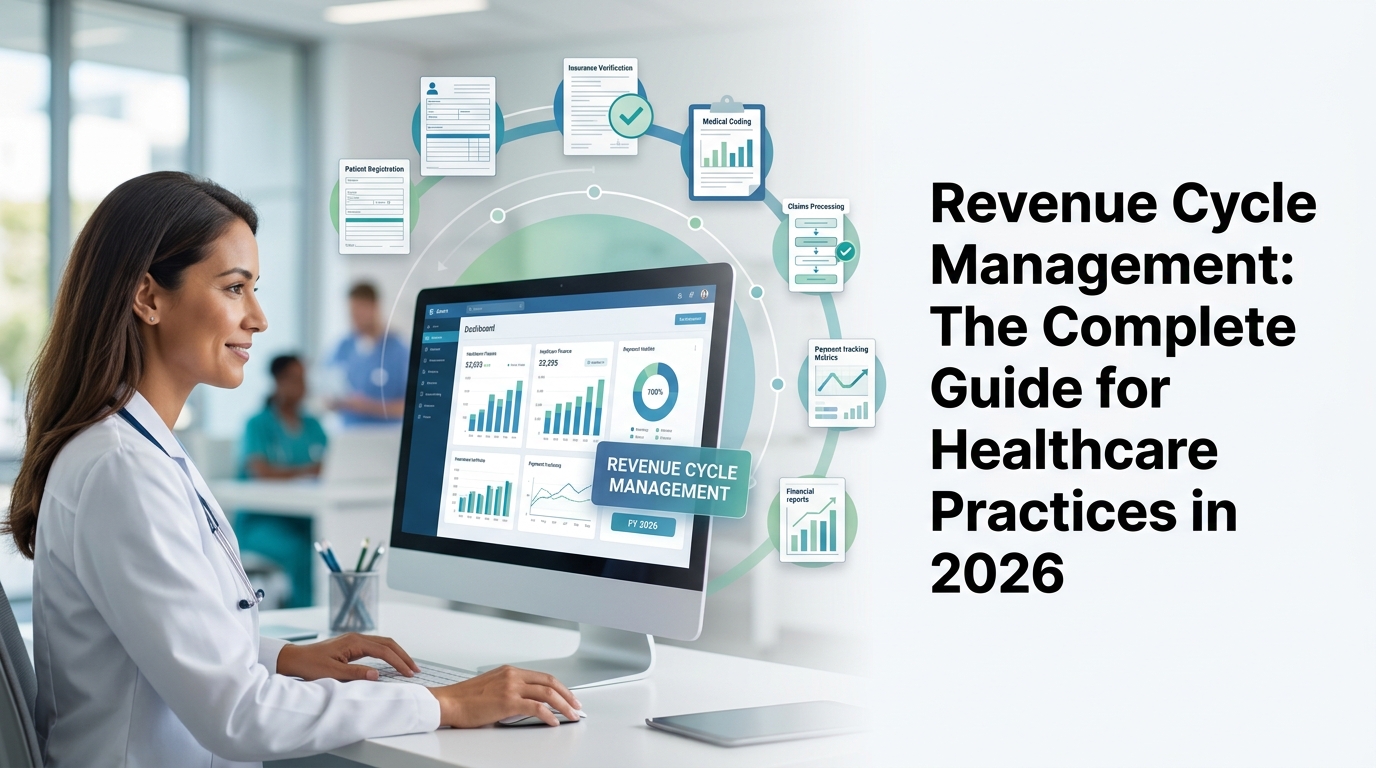
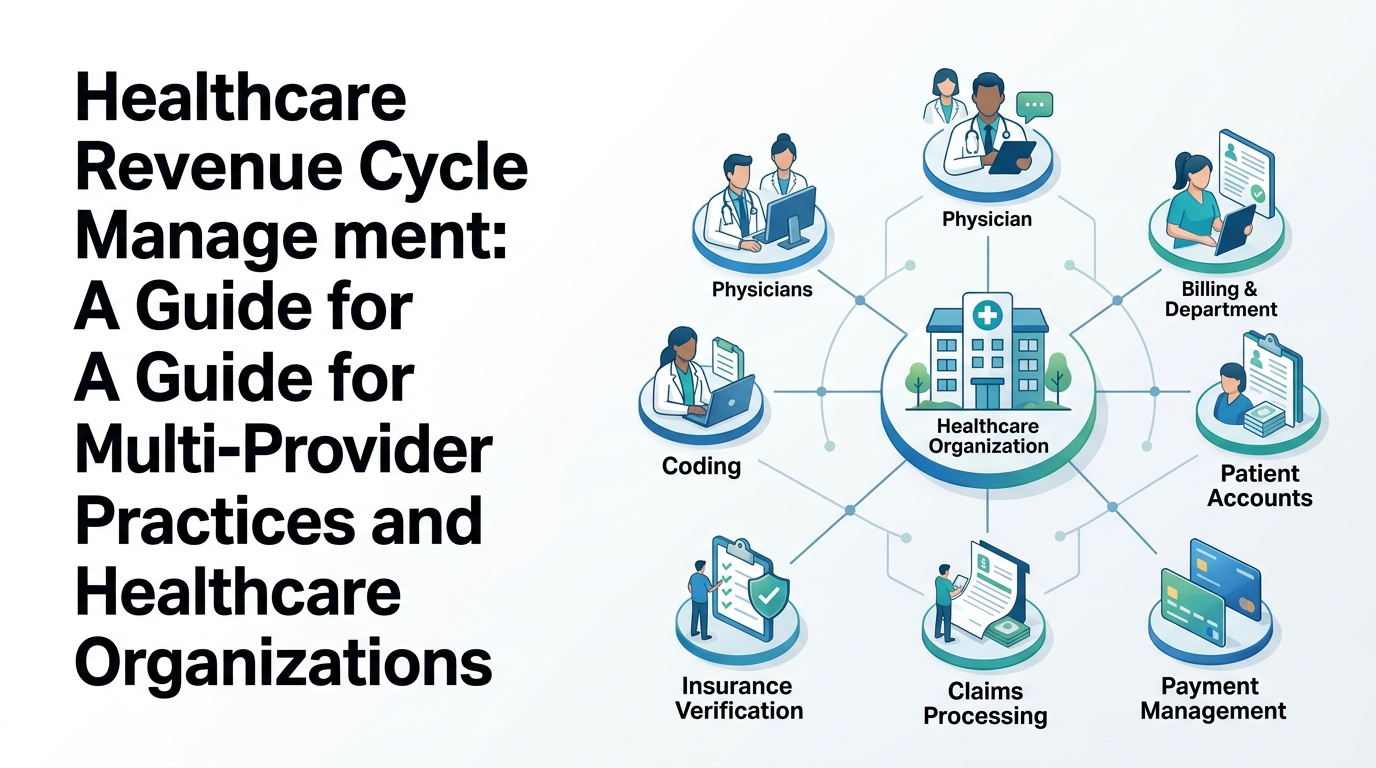
Healthcare Revenue Cycle Management: A Guide for Multi-Provider Practices and Healthcare Organizations

A single-physician practice and a multi-location healthcare organization both depend on the same basic process — turning patient care into collected revenue — but the scale changes everything about how that process has to be managed. Healthcare revenue cycle management at an organizational level means standardizing billing, coding, and reporting across multiple providers, locations, and sometimes specialties, while keeping every one of them compliant and visible from a single set of numbers.
This guide looks at healthcare revenue cycle management from that organizational vantage point: what changes at scale, where industry-wide automation is heading, and what healthcare organizations should expect from a billing partner capable of supporting more than a single-location practice.
What Changes When Revenue Cycle Management Scales Across an Organization
For a solo practice, revenue cycle management means managing one set of payer contracts, one EMR/EHR system, and one billing workflow. For a healthcare organization — a multi-location group, a network of clinics, a health system — healthcare revenue cycle management means doing all of that consistently across every location, often across multiple specialties, sometimes across multiple EMR/EHR platforms inherited through growth or acquisition.
That consistency is harder than it sounds. Different locations can end up with different documentation habits, different front-desk eligibility processes, and different levels of coding accuracy, even under the same organizational umbrella. Without centralized oversight, a problem at one location — a denial trend, an eligibility gap, a coding inconsistency — can go unnoticed far longer than it would at a single practice where one person sees everything.
Why Healthcare Revenue Cycle Management Has Become an Organizational Priority
The pressure on billing performance isn’t limited to small practices. According to MGMA’s most recent DataDive benchmarking data, the single-specialty aggregate rate for claims denied on first submission has held around 8%, and a 2024 MGMA poll found that 60% of medical group leaders — not just solo practitioners — reported an increase in their organizations’ claim denial rates compared to the year before. At organizational scale, an 8% denial rate across tens of thousands of monthly claims represents a significantly larger absolute dollar figure than the same rate at a single practice, which is exactly why healthcare organizations are investing more deliberately in how this function is managed.
Administrative burden compounds the pressure. A recent American Medical Association survey found that physicians complete an average of 43 prior authorizations per week, consuming roughly 12 hours of physician and staff time weekly — a load that multiplies across every provider in a multi-physician organization and quickly becomes a staffing and workflow problem, not just a billing one.
The Industry-Wide Shift Toward Automation
Technology adoption is accelerating industry-wide, and the data helps explain the urgency. The CAQH Index, an annual benchmark of administrative transactions across U.S. healthcare, found that the industry avoided an estimated $258 billion in administrative costs in 2024 through electronic transactions and better data exchange — and identified another $21 billion in savings still available by fully automating the manual and partially manual steps that remain. More than half of health plans and roughly a quarter of provider organizations now use AI tools somewhere in their administrative workflows, according to the same report, with administrative cost avoidance through automated transactions rising 17% year over year.
For a healthcare organization managing revenue across multiple locations, that shift shows up as centralized eligibility verification, claim scrubbing applied consistently regardless of which location submitted the claim, and reporting that rolls up location-level performance into a single organizational view — rather than each site tracking its own numbers in isolation.
What Enterprise-Level Healthcare Revenue Cycle Management Should Include
A billing partner capable of supporting a multi-location healthcare organization needs to handle a few things a single-practice vendor relationship doesn’t require:
- Centralized reporting across locations, with insurance verification and medical coding standardized the same way at every site. Organizational leadership needs one dashboard showing performance by location and in aggregate, not location managers emailing separate reports.
- Consistent coding standards across providers and sites. The same documentation should produce the same coding outcome regardless of which location or provider submitted it.
- Multi-EMR/EHR compatibility. Organizations that have grown through acquisition often run more than one clinical system, and billing needs to work across all of them.
- Scalable denial management. Denial trends need to be visible at both the location level and the organizational level, so a problem specific to one site doesn’t get averaged out and missed.
- Compliance consistency. Audit readiness and documentation standards need to hold at every location, not just the ones with the most experienced staff.
- Specialty flexibility. Multi-specialty organizations need coding and billing expertise that spans their full range of services, not just their largest department.
Governance: Who Should Own This at the Organizational Level
One of the most common gaps in healthcare revenue cycle management at scale isn’t technical — it’s organizational. When billing oversight is split across location managers with no single point of accountability, inconsistencies compound quietly: one site follows up on denials aggressively, another lets them age; one location verifies eligibility on every patient, another skips it during busy weeks. Larger organizations get the most value out of this function when there’s a clear owner — whether an internal RCM director or an outside partner functioning as one — with visibility into every location and the authority to standardize how claims are handled across all of them.
That single point of accountability is also what makes centralized reporting useful rather than just descriptive. A dashboard that shows ten locations’ worth of data doesn’t help much if no one is responsible for acting on what it reveals. The organizations that get this right treat reporting as the start of a feedback loop, not the end of one — a rising denial rate at one location should trigger a specific, tracked response, not just an entry in a spreadsheet someone reviews at quarter-end.
In-House vs. Outsourced Healthcare Revenue Cycle Management at Scale
Larger organizations sometimes assume that scale justifies building a large in-house billing department, and for some, it does. But scale also means the cost of inconsistency grows proportionally — a coding gap that affects one location’s billing staff can quietly repeat itself at every location using the same internal process, and fixing a systemic issue after it’s been running at scale for months is far more expensive than catching it early.
Medical billing outsourcing — specifically, healthcare revenue cycle management handled by a partner built for multi-location consistency — addresses that risk directly: standardized coding and claims processes get applied the same way everywhere, real-time reporting surfaces location-level problems immediately rather than at quarter-end, and the organization isn’t dependent on any single internal hire or team to maintain performance across every site.
Interoperability: The Quiet Challenge Behind Multi-System Organizations
Many healthcare organizations arrive at their current size through mergers, acquisitions, or adding locations over time — and each addition often comes with its own EMR/EHR system, its own payer relationships, and its own billing habits already in place. Reconciling that patchwork into something that reports consistently is one of the least visible but most consequential parts of scaling this function. A claim coded correctly in one system’s format may not translate cleanly into another’s reporting structure, and without active reconciliation, organizational-level metrics can end up quietly inaccurate — not because any single location did anything wrong, but because the data was never standardized to begin with.
This is part of why EMR/EHR compatibility matters more at the organizational level than it does for a single practice. A billing partner that only works cleanly with one system forces an organization to either standardize its clinical systems first — an expensive, multi-year undertaking on its own — or accept a billing relationship that only really works at some of its locations. A partner built to integrate across multiple platforms removes that bottleneck entirely.
Why Diamond Medical Billing Supports Healthcare Organizations
Diamond Medical Billing (DMB), a division of the Diamond Medical Network, is a medical billing company offering medical billing services and complete healthcare revenue cycle management for healthcare organizations and practices of every size, with certified coders, real-time reporting, and full compatibility across EMR/EHR systems. DMB’s standards are built to hold consistently, regardless of how many locations or providers a client organization has:
- 99.5% claims acceptance rate from first submission
- 65% success rate recovering underpaid and rejected claims
- 100% real-time reporting, so leadership always has a current, organization-wide view of performance
- 100% compatibility with all EMR/EHR systems
- Complete revenue cycle management, handled as one continuous process across every location served
These standards are backed by DMB’s core values: radical transparency, relentless advocacy for every dollar an organization has earned, uncompromising integrity in every claim, and a partnership-driven approach that scales with an organization rather than requiring it to adapt to a vendor’s limitations.
Frequently Asked Questions
How is organizational healthcare revenue cycle management different from managing billing at a single practice?
At scale, the challenge shifts from managing one workflow to standardizing that workflow consistently across multiple locations, providers, and sometimes EMR/EHR systems, while maintaining a single, organization-wide view of performance.
Can a healthcare organization use one billing partner across multiple EMR/EHR systems?
Yes, with the right provider. Diamond Medical Billing, for example, is built to be 100% compatible with all EMR/EHR systems, which matters particularly for organizations that have grown through acquisition and run more than one clinical platform.
What reporting should a multi-location organization expect from its billing partner?
Real-time dashboards that show both aggregate organizational performance and location-level detail, so a problem specific to one site is visible immediately rather than averaged out across the whole organization.
Does outsourcing healthcare revenue cycle management work for large, multi-specialty organizations?
It can, provided the partner has coding and billing expertise across the organization’s full range of specialties and the infrastructure to maintain consistent standards at every location it serves.
How is technology changing healthcare revenue cycle management at the organizational level?
Automation is increasingly handling eligibility verification, claim scrubbing, and denial-trend analysis at scale, but it works best paired with experienced billing staff who can act on what the data surfaces — not as a replacement for that expertise.
What should a healthcare organization look for when evaluating a billing partner’s scalability?
Ask specifically how the provider handles multi-location reporting, whether its team has experience integrating more than one EMR/EHR system, and how it maintains consistent coding and compliance standards across every site it serves — not just its largest or most established client.
The Bottom Line
Scale changes what good healthcare revenue cycle management requires — not the fundamentals, but the consistency, reporting, and infrastructure needed to apply those fundamentals the same way across every location and provider an organization serves. With denial rates rising industry-wide and automation reshaping how administrative work gets done, healthcare organizations that invest in standardized, centrally visible revenue cycle management are the ones best positioned to catch problems before they compound across the whole organization. Diamond Medical Billing was built to support exactly that: certified coding, real-time reporting, and standards that hold consistently regardless of an organization’s size.
Whether an organization manages two locations or twenty, the underlying question is the same: can leadership see, in real time, exactly how every site is performing, and is someone accountable for acting on what that view reveals? Ready to see what consistent, organization-wide healthcare revenue cycle management could do for your practices? Request a consultation with Diamond Medical Billing and get a clear picture of where performance varies across your locations.