
Medical Billing Services: The Complete Guide to Protecting Your Practice’s Revenue in 2026

For healthcare providers across the United States, the line between a financially healthy practice and one that constantly struggles with cash flow usually comes down to one thing: how well the practice manages its billing. Denied claims, coding errors, and slow reimbursements don’t just create administrative headaches — they represent revenue a practice has already earned but hasn’t collected. That gap is exactly why a growing number of medical practices, physicians, and healthcare organizations are turning to professional medical billing services rather than trying to manage an increasingly complex revenue cycle entirely in-house.
This guide explains what this kind of billing support actually includes, why it’s become essential for practices of every size and specialty, and how to evaluate a provider before you hand over a function this important to your practice’s financial health.
What Are Medical Billing Services?
Medical billing services cover the full set of administrative and financial tasks required to translate patient care into collected revenue. At a basic level, that means submitting claims to insurance payers and following up until they’re paid. In practice, a comprehensive billing services package goes far beyond claim submission — it includes medical coding, insurance eligibility verification, denial management and appeals, accounts receivable follow-up, compliance auditing, and financial reporting.
A practice can handle medical practice billing with an in-house staff, or it can outsource the work to a specialized medical billing company. Either way, the goal is the same: make sure every dollar a practice has legitimately earned actually reaches its bank account, on time and without unnecessary friction with payers.
Why Outsourced Billing Support Matters More Than Ever in 2026
Billing complexity has only increased in recent years, and the data backs that up. According to MGMA’s most recent DataDive benchmarking data, the single-specialty aggregate rate for claims denied on first submission has held around 8% — and a 2024 MGMA poll found that 60% of medical group leaders reported an increase in their practices’ claim denial rates compared to the prior year, while only 11% reported improvement. Practice leaders cited insufficient clinical documentation, eligibility errors, delayed filing, and improper modifier use among the most common causes.
The picture isn’t better on the payer-authorization side. A recent American Medical Association survey found that physicians complete an average of 43 prior authorizations per week, that this process consumes roughly 12 hours of physician and staff time weekly, and that 27% of physicians report prior authorization requests are often or always denied outright. It’s no surprise, then, that the market for outsourced medical billing in the U.S. has been growing at a double-digit compound annual rate, as more practices decide that navigating this complexity alone isn’t a good use of clinical staff time.
For an individual practice, these industry-wide trends translate into a very direct question: is your current billing process catching errors before they become denials, and is someone actively working every claim until it’s paid? If the honest answer is “not consistently,” that’s usually the moment a practice starts evaluating a medical billing company as an outside partner.
The Core Components of Professional Medical Billing Services
Not every billing services package is structured the same way, but a comprehensive offering generally includes the following six components.
Revenue Cycle Management
Revenue cycle management (RCM) is the backbone of medical billing services — it covers every step from charge entry and claims submission through denial management, appeals, accounts receivable follow-up, and final payment posting. Rather than treating each of these as a separate task, effective RCM manages them as one continuous process, so nothing falls through the cracks between submitting a claim and collecting on it.
Medical Coding
Accurate ICD-10 and CPT coding is where clean claims start. A single incorrect code can trigger a denial, delay payment for weeks, or create audit risk. Because coding requirements vary meaningfully by specialty, certified coders with specialty-specific experience are one of the most valuable parts of any billing and coding program.
Insurance Verification & Eligibility
Many denials trace back to a single preventable issue: coverage wasn’t confirmed before the appointment. Pre-service eligibility checks and real-time verification catch these problems before a claim is ever submitted, reducing rejected claims and giving patients a clearer picture of their financial responsibility up front.
Compliance & Audit Support
Compliance isn’t a once-a-year concern — it’s built into every claim a practice submits. Regular internal audits, documentation review, and staff training keep billing defensible and reduce the risk of a payer or regulatory audit turning into a serious problem.
Reporting & Analytics
A practice can’t manage what it can’t see. Dynamic dashboards and monthly financial reports give practice owners and administrators real-time visibility into collections, denial trends, and overall revenue cycle performance, rather than a summary that arrives weeks after the fact.
Consulting & Practice Optimization
Sometimes the fastest way to improve revenue isn’t a new billing team — it’s fixing the workflow underneath it. Workflow redesign, staff training, and technology integration help a practice get more out of the billing process it already has.
Signs Your Practice Needs Outsourced Medical Billing Services
Most practices don’t wake up one day and decide to outsource their billing — the decision usually builds gradually, as one or more of these warning signs becomes hard to ignore:
- Claim denial rates are climbing, or no one is tracking them consistently
- Days in accounts receivable keep creeping upward
- Underpaid or partially paid claims go unnoticed and unappealed
- Billing staff turnover keeps disrupting continuity
- Your practice has grown faster than your billing team’s capacity
- You don’t have real-time visibility into your practice’s revenue cycle performance
- Coding errors or compliance concerns keep surfacing during internal reviews
- Front-desk and billing staff are spending more time on insurance follow-up than patient care
If two or three of these sound familiar, it’s usually a sign that partnering with a medical billing company would pay for itself in recovered revenue and staff time alone.
In-House Billing vs. Medical Billing Services: Which Is Right for Your Practice?
Both approaches can work, but they come with different trade-offs. In-house billing gives a practice direct day-to-day control, but it also means absorbing the cost of hiring, training, and retaining specialized staff — and covering that expertise gap whenever someone leaves. Certified coders and experienced billers are in high demand, and turnover in a small in-house team can quietly stall a revenue cycle for months.
An outsourced billing partner, by contrast, gives a practice access to a full team of certified coders and billing specialists without the overhead of building that team internally. A good provider brings dedicated attention to a practice’s account, integrates with the EMR/EHR system the practice already uses, and is measured on the same standards it would set for its own performance: claims acceptance rate, days in A/R, and net collection rate. For many practices — especially smaller and mid-sized ones — that tradeoff increasingly favors partnering with a specialized medical billing company rather than building the function from scratch.
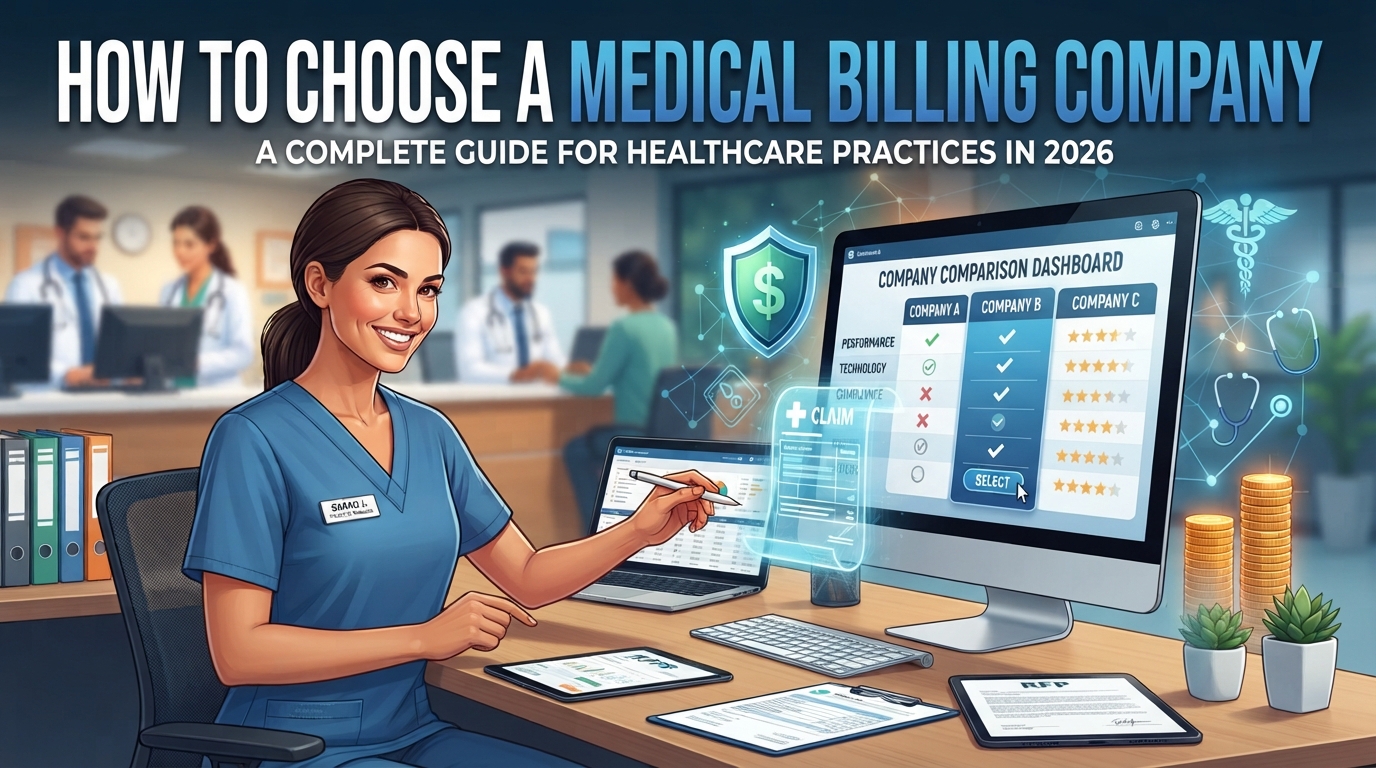
How to Choose a Medical Billing Services Provider
Not every billing company delivers the same results, so it’s worth evaluating a few concrete factors before signing an agreement:
- Claims acceptance rate. Ask what percentage of claims are accepted on first submission. This single number says a lot about how carefully claims are reviewed before they go out.
- Denial and underpayment recovery. A provider should be able to describe, specifically, how it handles denied and underpaid claims — not just that it “follows up.”
- Reporting transparency. Real-time dashboards and regular reporting matter more than a promise of “good communication.” You should be able to see your own numbers whenever you want to.
- EMR/EHR compatibility. Your billing partner should integrate with the systems your practice already uses, not force a disruptive switch.
- Specialty experience. Coding and documentation requirements differ by specialty — a provider with direct experience in your specialty will make fewer avoidable errors.
- Compliance practices. Ask how the provider handles internal audits, documentation review, and staff training around compliance.
A provider that can answer each of these questions with specifics — not generalities — is usually a safer bet for handing over a function as important as your revenue cycle.
Data Security and HIPAA Compliance: What to Expect
Handing over billing means handing over protected health information, so data security isn’t optional — it’s a baseline requirement. A trustworthy billing partner operates under a signed Business Associate Agreement (BAA), encrypts patient data both in transit and at rest, restricts staff access on a need-to-know basis, and maintains audit logs that can withstand a HIPAA compliance review. Before signing with any provider, ask directly how patient data is stored, who can access it, and what happens in the event of a security incident. A provider that can’t answer clearly isn’t ready to handle a practice’s billing, regardless of how competitive its pricing looks on paper.
Why Healthcare Providers Choose Diamond Medical Billing
Diamond Medical Billing (DMB), a division of the Diamond Medical Network, provides complete healthcare revenue cycle management and medical billing services for practices, with certified coders, real-time reporting, and full compatibility across EMR/EHR systems. Rather than asking practices to take performance on faith, DMB is built around measurable standards:
- 99.5% claims acceptance rate from first submission
- 65% success rate recovering underpaid and rejected claims
- 100% real-time reporting, so practices always have a current view of their revenue cycle
- 100% compatibility with all EMR/EHR systems
- Complete revenue cycle management, handled as one continuous process rather than a patchwork of vendors
These standards are backed by DMB’s core values: radical transparency, relentless advocacy for every dollar a practice has earned, uncompromising integrity in every claim, and a partnership-driven approach that treats each client’s billing as if it were DMB’s own revenue on the line. For practices searching for medical billing services built on accountability rather than promises, that combination of certified expertise, technology, and transparent reporting is the difference between a vendor and a genuine billing partner.
Frequently Asked Questions
What do medical billing services typically include?
A comprehensive billing and revenue cycle package includes claims submission, medical coding, insurance eligibility verification, denial management and appeals, accounts receivable follow-up, compliance auditing, and financial reporting — managed as one connected process rather than separate tasks.
How much can medical billing outsourcing save a practice?
Savings vary by practice, but they typically come from three places: fewer denied claims that need to be reworked, faster collection on accounts receivable, and reduced overhead compared to hiring and training in-house billing staff.
Is outsourcing your medical billing safe for compliance?
Yes, when the provider treats compliance as a standing part of its process — certified coding, regular internal audits, and documentation review — rather than something addressed only after a problem appears.
How do I know if my practice needs professional medical billing services?
Rising denial rates, aging accounts receivable, limited visibility into revenue cycle performance, and billing staff turnover are the most common signs that it’s time to evaluate an outsourced medical billing company.
Do medical billing services work with the EMR/EHR system my practice already uses?
A good provider should. Diamond Medical Billing, for example, is built to be 100% compatible with all EMR/EHR systems, so billing fits into a practice’s existing workflow rather than forcing a switch.
The Bottom Line
Billing complexity isn’t going away — if anything, rising denial rates and administrative burden mean the cost of an inefficient revenue cycle keeps climbing. Whether a practice ultimately keeps billing in-house or partners with an outside provider, the underlying goal doesn’t change: collect every dollar that’s been earned, as quickly and transparently as possible. For practices ready to make that shift, working with an experienced medical billing services provider like Diamond Medical Billing means certified coding, real-time reporting, and a team that treats denial prevention and revenue recovery as a daily discipline rather than an afterthought.
Ready to see where your practice’s revenue cycle can improve? Request a consultation with Diamond Medical Billing and get a clear picture of what better billing could mean for your practice’s bottom line.